Upcoming Events
24.02.2026 Technical Contest: "Bug Buster" 27.02.2026 Workshop: Intelligent Threat Detection & Data Privacy (OWASP Top 10) 02.03.2026 Gender Sensitization: Cultivating Knowledge, Compassion, and Responsibility 02.03.2026 to 09.03.2026 Six-Day FDP: Computational Intelligence (For Faculty) 04.03.2026 Two-Day Workshop: Building REST APIs with Node.js 11.03.2026 Workshop: Build AI Applications with Multiple LLM Models
about-img

About

The Department of Computer Science and Engineering (CSE) at Vel Tech Rangarajan Dr. Sagunthala R&D Institute of Science and Technology, established in 1997, is a premier academic and research department committed to excellence in teaching, research, innovation, and professional practice. Over the years, the department has demonstrated sustained growth in academic offerings, student intake, faculty strength, and research output.

Programs include B.Tech (CSE), M.Tech (CSE), M.Tech (Big Data Analytics), and Ph.D. (CSE). The doctoral program (since 2009) supports full-time and part-time scholars and has strengthened the department's research ecosystem.

The department is supported by a robust faculty strength of 264 highly qualified faculty members with rich experience in teaching, research, and industry practices. Faculty members actively engage in scholarly research, funded projects, patents, professional society activities, curriculum development, and student mentoring. Continuous professional development is emphasized through Faculty Development Programmes, Short Term Training Programmes, MOOCs, Industry Training Programs, and e-content Development, ensuring pedagogical excellence and technological relevance.

A strong research and development culture is a defining strength of the department. Faculty members have published extensively in high-impact journals and reputed international conferences, secured patents, and guided doctoral research. The department has received significant sponsored research funding from national agencies, with a total research grant amount exceeding ₹273.48 lakhs. These funded projects have led to tangible outcomes such as research publications, student involvement, infrastructure enhancement, interdisciplinary collaboration, and societal impact.

The department rigorously implements the Outcome-Based Education (OBE) framework, fully aligned with NBA guidelines and Washington Accord requirements. Curriculum design and revision follow a structured process involving the Board of Studies, Industry experts, Alumni, Academic peers, Employers input, and student feedback, ensuring alignment with emerging domains such as Artificial Intelligence, Machine Learning, Data Science, Big Data Analytics, Cyber Security, Cloud Computing, and Computer Vision.

The department places strong emphasis on student-centric and experiential learning, encouraging students to participate in innovative projects, internships, NPTEL courses, professional certifications, hackathons, IEEE activities, and industry-supported programs. These initiatives have resulted in strong academic performance, competitive placements, and national-level recognitions.

Supported by state-of-the-art laboratories, industry-supported facilities, advanced computing infrastructure, and digital learning platforms, the Department of CSE ensures holistic development of students. Continuous improvement practices driven by outcome attainment analysis and stakeholder feedback enable the department to consistently enhance academic quality and graduate attributes.

The Department of Computer Science and Engineering exhibits an outstanding placement record, driven by strong industry collaborations and comprehensive student preparation. Premier recruiters including TCS, Accenture, Capgemini, Genpact, LTI Mindtree, and CTS actively seek our graduates, highlighting their exceptional technical expertise and market readiness. This success underscores the department's dedication to developing professionals who thrive in global, high-impact roles.

The Department of Computer Science and Engineering remains committed to nurturing competent, ethical, innovative, and socially responsible computing professionals, capable of excelling in industry, research, entrepreneurship, and higher education at national and global levels.
Read More

ABET- EAC AND CAC STUDENT OUTCOMES

At the time of the graduation, B.Tech. CSE program Students are expected to know and be able to do the following ABET-EAC and ABET-CAC Student Outcomes that relate to knowledge, skills and behavior of the students.

ABET – EAC Student Outcomes

  1. An ability to identify, formulate, and solve complex engineering problems by applying principles of engineering, science, and mathematics.
  2. An ability to apply engineering design to produce solutions that meet specified needs with consideration of public health, safety, and welfare, as well as global, cultural, social, environmental, and economic factors.
  3. An ability to communicate effectively with a range of audiences.
  4. An ability to recognize ethical and professional responsibilities in engineering situations and make informed judgments, which must consider the impact of engineering solutions in global, economic, environmental, and societal contexts.
  5. An ability to function effectively on a team whose members together provide leadership, create a collaborative and inclusive environment, establish goals, plan tasks, and meet objectives.
  6. An ability to develop and conduct appropriate experimentation, analyze and interpret data, and use engineering judgment to draw conclusions.
  7. An ability to acquire and apply new knowledge as needed, using appropriate learning strategies.

ABET – CAC Student Outcomes

  1. Analyze a complex computing problem and to apply principles of computing and other relevant disciplines to identify solutions.
  2. Design, implement, and evaluate a computing-based solution to meet a given set of computing requirements in the context of the program’s discipline.
  3. Communicate effectively in a variety of professional contexts.
  4. Recognize professional responsibilities and make informed judgments in computing practice based on legal and ethical principles.
  5. Function effectively as a member or leader of a team engaged in activities appropriate to the program’s discipline.
  6. Apply computer science theory and software development fundamentals to produce computing-based solutions.
VISIONARY LEADERSHIP

Head of Department

Leading Excellence in Computer Science & Engineering Education

HOD Dr. kavitha
23+ Years
Experience
Department Leadership

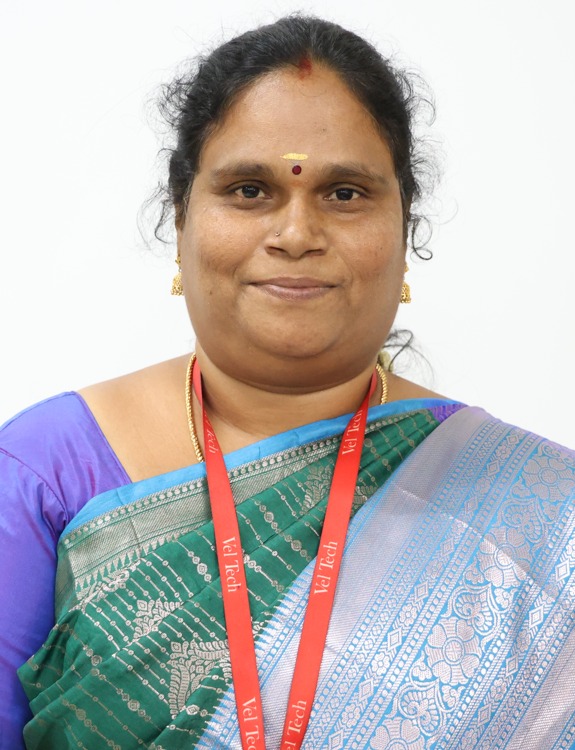
Dr. M. Kavitha

Head of Department, CSE

Dr. M. Kavitha is a Professor in the Department of Computer Science and Engineering at Vel Tech Rangarajan Dr. Sagunthala R&D Institute of Science and Technology, with over 23 years of distinguished teaching and research experience. She began her academic journey at the University of Madras, Chennai, where she earned her Bachelor’s degree in Computer Science and Engineering. She subsequently completed her postgraduate studies at Anna University, Chennai, and earned her Ph.D. in Computer Science and Engineering from Vel Tech Rangarajan Dr. Sagunthala R&D Institute of Science and Technology.

As Head of Department, she champions innovation, academic excellence, industry partnerships, and student success. Her vision is to transform CSE education and produce globally competent computing professionals.

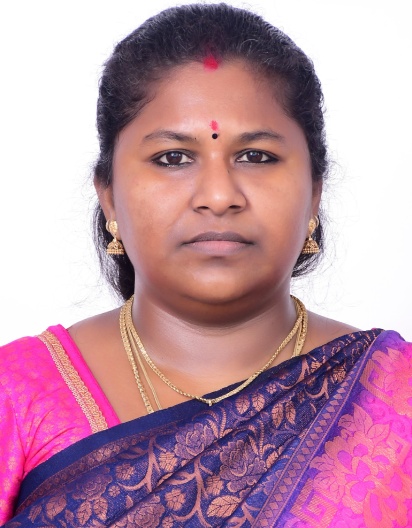
Dr. T. Kujani

Assistant Head of Department, CSE

Dr. Kujani T, Associate Professor in the Department of Computer Science and Engineering with 21 years of teaching experience and a strong research background. Specializes in Artificial Intelligence, Machine Learning, Deep Learning, and Data Analytics. Actively engages in innovative teaching, research publications, and guiding student projects. Demonstrates strong administrative and leadership skills, contributing to academic planning, curriculum development, outcome-based education, and departmental coordination. Shows a keen interest in emerging technologies, knowledge sharing, and mentoring students and faculty. Remains committed to academic excellence, continuous learning, and contributing to institutional growth and quality enhancement.

HOD Dr. Kujani
21+ Years
Experience
Programmes Offered

Our Programs

All programmes are approved by AICTE || B.Tech. programme is accredited by NBA under Tier-I (Washington Accord) category.

UG Programs

UG Programmes

B.Tech. Computer Science & Engineering

Specialization / Minor / Honors in:

  • Artificial Intelligence
  • Data Science
  • Cyber Security
  • AI & Machine Learning
  • AI & Data Science
  • AI & Robotics
  • Financial Technology
  • Gaming and Animation

PG Programs

PG Programmes

  • M.Tech. – Computer Science and Engineering
  • M.Tech. – Network Engineering
  • M.Tech. – Big Data Analytics
  • M.Sc. – Data Analytics

PhD Programs

Ph.D. Programmes

Ph.D. – Computer Science & Engineering

Advanced doctoral research program offering opportunities to pursue innovative research in emerging areas of Computer Science and Engineering including Artificial Intelligence, Machine Learning, Data Science, Cyber Security, Cloud Computing, and Computer Vision. Faculty mentorship and access to state-of-the-art research facilities ensure academic excellence and impactful research contributions.

  • Project Based Learning Workspace - Wipro Centre of Excellence
  • CapGemini Centre of Excellence
  • Centre for Development of Advanced Computing (C-DAC)
  • CMC Limited
  • IBM
  • ITI Limited
  • Modern Communication and Broadcast System Pvt. Lt. (MCBS) & NICIT
  • Tata Consultancy Services (TCS)
  • CSC
  • EMC2
  • Infosys Technologies
  • National Informatics Centre
  • Telecom Sector Skills Council (TSSC)
OUR PURPOSE & DIRECTION

Vision & Mission

Guiding principles that shape academic excellence, innovation, and societal impact.

Our Vision

To produce intellectual graduates who could contribute significantly in the analysis, design, development, operation and maintenance of complex software systems for meeting the ever changing requirements of service systems and to compete globally towards professional excellence.

Our Mission

  • M1: Design curricula for imparting training in adapting newer computing methods and technologies for providing effective and efficient solutions to the existing / new problems.
  • M2: Emphasizing in-depth knowledge of the subjects by employing Information and Communication Technology (ICT) based pedagogy methods.
  • M3: Creating a conducive research environment for making technological innovations by the faculty and students.
  • M4: Providing leadership skills and professional ethics thereby making a prolific career in academics and industry.
picture

  • PEO1: Formulate, solve and analyze CSE problems using fundamentals.
  • PEO2: Apply cutting-edge technologies for social responsibility.
  • PEO3: Demonstrate teamwork, leadership and ethics.
  • PEO4: Pursue higher education and lifelong learning.

  • PO1: Engineering Knowledge: Apply knowledge of mathematics, natural science, computing, engineering fundamentals and an engineering specialization as specified in WK1 to WK4 respectively to develop solutions for complex engineering problems.
  • PO2: Problem Analysis: Identify, formulate, review research literature and analyze complex engineering problems reaching substantiated conclusions with consideration for sustainable development. (WK1 to WK4)
  • PO3: Design/Development of Solutions: Design creative solutions for complex engineering problems and design/develop systems, components, and processes to meet identified needs with consideration for public health and safety, whole-life cost, net zero carbon, culture, society, and environment as required. (WK5)
  • PO4: Conduct Investigations of Complex Problems: Conduct investigations of complex engineering problems using research-based knowledge including design of experiments, modelling, analysis, and interpretation of data to provide valid conclusions. (WK8)
  • PO5: Engineering Tool Usage: Create, select and apply appropriate techniques, resources, and modern engineering & IT tools, including prediction and modelling, recognizing their limitations to solve complex engineering problems. (WK2 and WK6)
  • PO6: The Engineer and The World: Analyze and evaluate societal and environmental aspects while solving complex engineering problems for their impact on sustainability with reference to economy, health, safety, legal framework, culture and environment. (WK1, WK5, and WK7)
  • PO7: Ethics: Apply ethical principles and commit to professional ethics, human values, diversity and inclusion; adhere to national and international laws. (WK9)
  • PO8: Individual and Collaborative Team Work: Function effectively as an individual, and as a member or leader in diverse/multidisciplinary teams.
  • PO9: Communication: Communicate effectively and inclusively within the engineering community and society at large, such as being able to comprehend and write effective reports and design documentation, and make effective presentations considering cultural, language, and learning differences.
  • PO10: Project Management and Finance: Apply knowledge and understanding of engineering management principles and economic decision-making to one’s own work, as a member and leader in a team, and manage projects in multidisciplinary environments.
  • PO11: Life-Long Learning: Recognize the need for and have the preparation and ability for (i) independent and life-long learning, (ii) adaptability to new and emerging technologies, and (iii) critical thinking in the broadest context of technological change. (WK8)

  • PSO1: Mathematical modeling using algorithms.
  • PSO2: Software design & development skills.
  • PSO3: Real-world problem solving ability.

  • Artificial Intelligence
  • Cloud Computing
  • Data Mining
  • Image Processing
  • Network Security
  • Wireless Sensor Networks

shep
shep

Faculty Achievements